

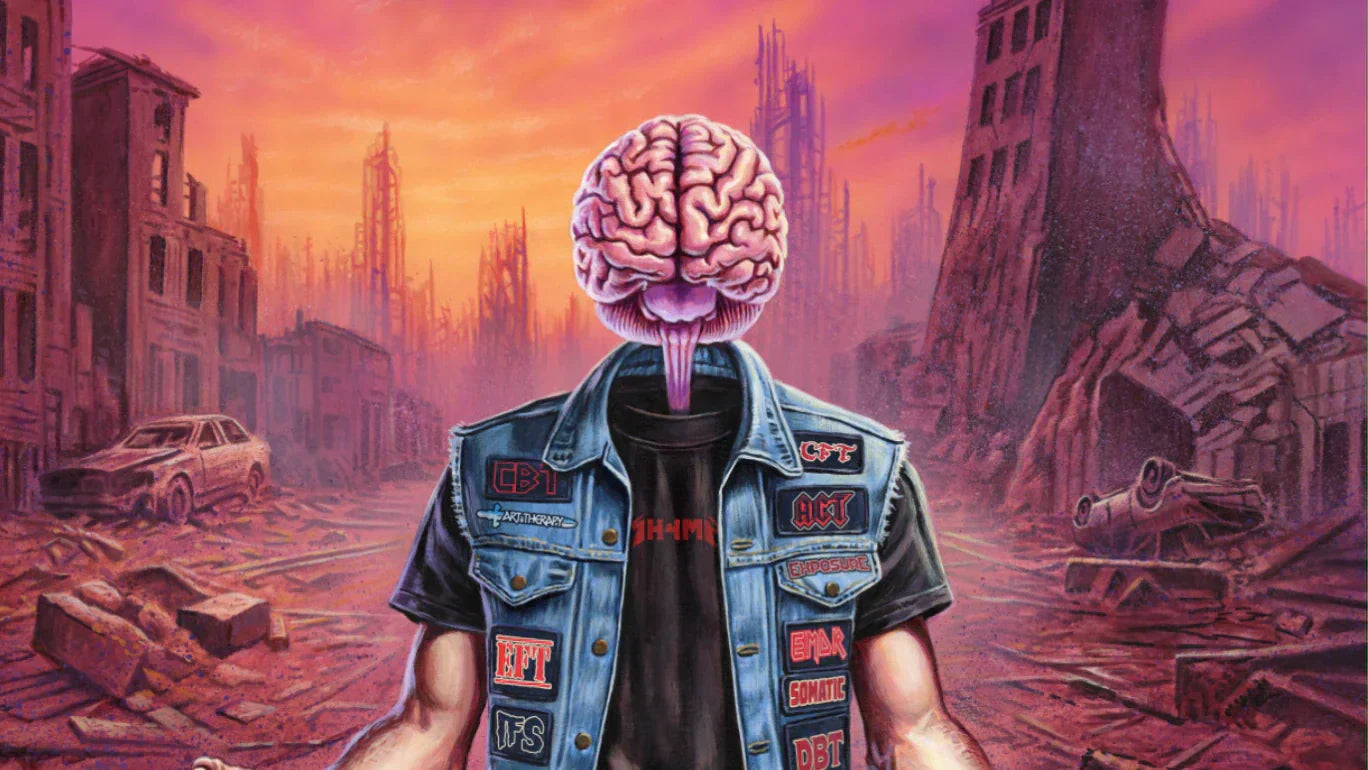
AUTHOR JAMES NEESON ON HEAVY MUSIC, SELF-HELP, AND ROCKING YOUR WAY TO WELLBEING
Heavy music and mental wellbeing have long shared a connection. For some, metal is catharsis. For others, it’s community, identity, or simply the soundtrack that helps us make it through difficult times.
Yet despite the growing conversation around mental health, much of the self-help world can still feel distant from the people it’s supposedly trying to reach. That’s exactly what prompted author and registered nurse James Neeson to write Mental Health for Metalheads: a self-help guide aimed squarely at the heavy music community.
Blending practical mental health advice with humour, empathy, and a deep love of metal culture, the book translates concepts from therapy and psychology into something far more accessible for people who might never normally pick up a self-help book.
Mental health awareness is something we care deeply about at TEN OF CLUBS — which is why we support Music Minds Matter — so, ahead of the book’s release, we had a nice long chat with James, discussing his own experiences with mental illness, the therapeutic power of heavy music, the realities of self-help, and why he believes metalheads are uniquely positioned to understand both pain and resilience.
For battle jackets, breakdowns, and why self-help books need more Tony Iommi — read on!
♣︎ ♣︎ ♣︎
Hello James. Welcome to The Winchester. What are you drinking?
JAMES NEESON — Can I have a chamomile tea? I’m teetotal.
This is a pub — we don’t usually do tea, let alone chamomile, but for you we’ll make an exception. At least it wasn’t lapsang souchong. Please introduce yourself.
I'm a registered nurse living in Wales and originally from Northern Ireland, as you can probably tell by my accent. I’ve written the self-help book Mental Health for Metalheads.
Tell us more.
Mental Health for Metalheads is the greatest hits playlist of self-help and therapy, but curated and translated for metal fans.
A lot of the self-help industry is American, and some of it can be quite religious. A lot of it is very focused on pastel colours and gentle rainbows, and it's not necessarily fitting for people who listen to bands like, you know, Driller or Rancid.
This book’s more skulls and pentagrams than pastels and woolly jumpers.

It sounds right up our Strasse. What exactly can we expect?
Each of the chapters is named after metal songs and, a bit like a playlist, it’s designed to be non-linear. Like, if you don’t want to hear Stairway to Heaven, you can skip it and still find something useful. You can pick the bits that suit you.
Rather than releasing one self-help book and then another over a couple of years, I’ve basically done three books’ worth of content all in one go, all for one price. I’m not trying to make money here; it’s genuinely to help people. So I’ve brought together kind of everything that’s relevant.
The analogy I use is that it’s like a battle jacket. There’s only so much space in your life, there are only so many hours in your day. You can’t do everything from the world of therapy or self-help, so I’m going to show you all the best bits and you can pick which patches you want to put on your jacket.
What kind of topics does it cover?
The first few chapters are a general mental health overview. Then there are chapters on how the brain and nervous system work, and the idea that you’re not broken even if you feel you are.
Then it goes into the three most helpful things you can do for your mental health — which are also the three most helpful things you can do for your physical health, because your mental health is physical too. It lives in your brain, and your brain is an organ in your body, just the same as your heart or your lungs. So there are chapters devoted to sleep, eating, and exercise.
Then there's a section on things you can do with your brain, ways of using your attention, different tricks from different types of therapy for managing thoughts. There is a chapter on positive mental attitude, and a chapter on affirmations and how, even though they seem like they might be bullshit, there's actually some science there. There’s also anger management, mindfulness, and breathing.
This book’s more skulls and pentagrams than pastels and woolly jumpers.
— James Neeson —
Are we talking general advice or practical steps?
The book is very much about taking actionable steps and not being too hypothetical. It uses a coaching model to kind of get you to try it for long enough, and seriously enough, and in a way that’s applicable for you.
If something doesn’t work for you, it doesn’t mean you’re broken and destined to a lifetime of suffering. It just means that you need to try something else.
Did you have a specific audience in mind when you were writing? Is this a book for self-help veterans or newbies?
Both. I had three audiences in mind. One is people with no diagnosis but who know something's not right and need to finally help themselves. Two is people living with someone who's struggling but they don't know how that person feels or what they need. For example, the mother of a teenage metalhead with borderline personality disorder, or EUPD as it's called nowadays.
And then the third one is people who have tried some things and they didn't work and now they feel like they're broken and unfixable and that they're treatment-resistant and incurable. Mental illness has a way of making you feel like a defeatist. It makes you think you are the exception.
That’s so true — that despairing sense that you’re beyond help and too far gone.
Yeah, you try this or that therapy, but it doesn’t work and you’re left thinking that you’re so much worse than anybody else. The book tries to give you hope that there is hope. You just need to experiment and learn. You’re not too broken; it's not too late.
The reason this book is so long is because you're not meant to read it from cover to cover in one sitting. It gives you, like, 500 different things to try. I wanted to get it to 666, but that was just too long.
If you try seven things that don’t work for you, there are still 493 more. Plus, you haven't tried them in all of the combinations you could.
What’s the tone of your book? Is it deadly serious? Are there any jokes?
One of the main influencers for the book is the stand-up comedian Andrew O’Neill and his book A History of Heavy Metal. That book is really, really funny. There are a lot of footnotes that are actually punchlines. I used that. You’ll find lots of times where I’ve written a serious scientific discussion of how your brain works, or your nervous system, or hormones, and then I’ll make a joke in the footnotes. That was definitely inspired by Andrew O'Neill.
The book is packed full of empathy. This is a book I wish my 16-year-old self could have read. This isn’t your grandmother wagging her finger. I know you don’t want to feel like this: it sucks. You’re not an idiot, and I’m not here to patronise you.
What prompted you to write the book?
Basically, when I was ill, it never occurred to me to get a self-help book. It just didn’t seem like something that was relevant to me. There wasn’t anything out there that I’d be interested in. Everything I do is rock or metal related. If I read a book, it’ll be like Dee Snider or Ozzy Osbourne’s autobiography. If I play a video game, it’s one with a heavy metal soundtrack.
When I got well, one of the things that struck me was that I could have got well a lot sooner if somebody had actually marketed this stuff towards me. I thought, maybe there’s some other 16-year-old version of me out there, or a 60-year-old version of me, who’s in trouble and never thought to look at the self-help section because the books don’t have pictures of Tony Iommi on the cover. So I thought I’d write one.
Are you able to tell us a little more about your own struggles with mental health?
Sure. When I was little, before I even knew what self-harm was, I would bite my wrists until they bled, or bang my head against the wall — you know, the bad kind of headbanging, not the good kind. I was one of those kids you see parodied on sitcoms and stuff: “I didn’t ask to be born. I don’t want to be here.”
When I got to adolescence and got bullied, and the hormones started going, it just kind of got worse and worse. The self-harm became knives instead of teeth. Instead of “I don’t want to be here,” it’s like “I am planning to kill myself,” etc.
My parents tried to get me to speak to a counsellor or a doctor, but I wouldn’t. You know, you’re afraid of how you’ll be perceived, so you just lie to them: “No, I’m fine; it’s all good.”
You’re not too broken; it’s not too late.
— JAMES NEESON —
Did you ever seek help?
Yes, when I was an adult. I was just struggling for years and years until I basically got dragged kicking and screaming to doctors, and therapy, and medicines, and self-help. And that was massive and life-changing. I remember thinking, if only somebody had sold this to me 20 years ago, everything would have been so much easier, better, different.
That’s the purpose of this book: it’s for anyone else like me who’s not wanting to get help, not wanting to try meds, not wanting to go to therapy, not wanting to get a diagnosis, etc., etc. Like, a quarter of all the people in Britain are mentally ill in some way or another. I just thought, maybe I can do something to help other people.
Was there a specific moment that prompted you to start writing?
Yeah, kind of. I’ve always enjoyed writing: blogs, concert reviews, Amazon reviews of CDs, and stuff. When my mum got diagnosed with cancer, we were having those kind of final conversations, and she said I should try doing something with my creativity. I was always against it. I knew working a nine-to-five job wasn’t fulfilling, but I also had to provide for the family, get a pay cheque, get a house.
But I had a bit of a burnout/breakdown when Mum was diagnosed, and that made me start reading a lot of self-help. That was when I was like, “Hold on, I could combine the two and maybe help others.”
Did you do a lot of research before putting pen to paper?
Yes, I put 18 months into researching it. I learned a lot from exposure to so many ideas. I gained new perspectives. But there’s so much information out there, you can’t and will never know everything.
And there are so many types of therapy: CBT, DBT, CAT, ACT, SET. There are more acronyms than you’ll find on the poster for a hardcore punk show.
Did your research change your perspective on mental health?
I'd say so, yes. Writing is in and of itself therapeutic. There's a blogger called 80s Metal Man — his real name's Michael Lefevre, and he’s written a great book called Rock and Roll Children — and he said in one of his blogs that he was writing as a therapeutic tool and it was healing for him to write it. I was like, “Yeah, I’d like some healing, please.” I guess I kind of got the idea from him to write a book.
And then the other thing was I stumbled across this psychologist on YouTube called Dr Scott Eilers, and he just really spoke to me. Like, I've never identified with someone so much. I just love the way he explains things. He's poetic and empathetic and just really gets mental health on a level I had never seen before.
He had written this book called For When Everything Is Burning. It's now my favourite book. I was basically like, “I want to do that.” It’s like, if that’s Black Sabbath, I want to be Sleep. If my book can publicise him to people that might not be looking for him, that would be a good thing for the world.
Were there any sections of the book that you found especially difficult or challenging?
The chapter on suicide prevention was challenging in an emotional way, as you can imagine. But there's a chapter on a type of therapy called IFS, which stands for Internal Family Systems, and it's a really different paradigm to anything I had come across in the NHS or elsewhere.
It basically asserts that everyone has lots of different sub-personalities. It categorises some of these sub-personalities as different jobs, like firefighters and managers, exiles, etc., and kind of explains that the different parts of you are all trying to keep you safe in different ways. It treats each one as if they're like actual different people. The way it explores these is unlike anything I’ve ever seen in UK healthcare.
Is metal therapeutic? Or is there something else about metal that calls out to people who struggle with mental health?
There have been many scientific studies about how the kind of people who are inclined to like heavy metal do get regulated by it. But it wouldn't regulate every human. If you played it to your 90-year-old grandfather who only ever listens to Chopin, it might distress him. But if you play it to that person who saw Paul Di’Anno on stage with Iron Maiden, it will make them feel better. Studies have shown that it is therapeutic to a certain demographic, for a whole bunch of scientific reasons that I won't go into now.
Equally, it does also appeal to people who’ve been bullied, who’ve been through trauma, who’ve had substance abuse issues, etc., because they see themselves reflected in the song titles, lyrics, artwork, imagery: the anger, the aggression, the power, the darkness. Part of you is validated. It’s subconscious, but it’s there.
The other thing is the camaraderie and community that comes with metal: the great feeling when you find people on your wavelength who look like you, or think like you, or talk like you. There’s an accepting community aspect to heavy music, be it hardcore, punk, whatever, that people identify with.
Even if you only get 5% better, that's a lot better than being 100% unwell.
— JAMES NEESON —
The book has great cover art. Who did it?
The beautiful cover art is hand-painted by Ed Repka, the king of 1980s thrash metal album art. He did the art for Megadeth’s Peace Sells... but Who’s Buying? and Rust in Peace, Death’s Leprosy and Scream Bloody Gore, and Nuclear Assault's Game Over.
I just emailed Ed to ask if he’d do it. Very out of character for me, at least for the first 30 years of my life, but therapy kind of tells you that nobody’s better than you and you’re no better than anyone else. We’re all just a bunch of monkeys bumbling around on a big rock in space.
The book’s out next week. How are you feeling about it?
I’m very pleased. One thing I’ve learned from therapy is to build things: to look forward, to stretch myself, to do things I’ve never done before, to expand my horizons, meet new people, learn new things, show myself I’m capable of things I didn’t think I was capable of. Writing this book has been all of those things.
I’ve already got to meet so many great people because of this book, including the aforementioned Dr Scott Eilers, who is now my hero. I sent him an email — a Hail Mary shot in the dark — asking if he’d be interested in writing the foreword to the book. It turns out he’s a big metal fan, so he did it. Fantastic.
I got interviewed by Vanessa Warwick, who used to be on Headbangers Ball on MTV. I’ve never been to Norway, but I got to meet the CEO of a Norwegian anti-bullying charity thanks to this book. And I wouldn’t be here speaking with you if it wasn’t for this book.
The process of stretching myself has permanently raised my self-esteem. I’ve accomplished something that I hope will help other people too. And half the proceeds go to the Sophie Lancaster Foundation charity — so even if the contents of the book don’t help people, at least the sale of the book will.
What do you hope people take away from the book?
That your mental health is not something intangible, spiritual, mystical, ethereal. It is entirely physical and biological. It is to do with your brain, your nervous system, your gut microbiome, and all the interactions between the hormones, neurotransmitter chemicals, and electrical signals therein.
You are not helpless. You just haven't figured out which help you need yet, and tried it in the right combination for long enough. If you adopt a mindset of exploring what works for you personally, you can really improve your life. Even if you only get 5% better, that's a lot better than being 100% unwell. And it compounds: every 5% improvement builds your capacity to get 10% better next time.
What else are you working on?
I have no plans to write at the moment, because I am a full-time nurse, parent, husband, etc. But I might start a mental health podcast for musicians, or something. Or I might get involved with heavy metal therapy and peer-support groups. Or I might start blogging.
Thanks James. We really appreciate you speaking with us and being so candid. Before we let you go, let’s just verify your metal credentials. Please give us three albums everyone should own.
- The Warning — Queensrÿche
- Wiseblood — Corrosion of Conformity
- Keeper of the Seven Keys: Part II — Helloween
Excellent choices — you know your onions. We wish you all the best with the book. When and where can folk get their hands on it?
The hardback is out on the first of June. The paperback and digital copies are out on the first of July.
The primary place to get it is Amazon, but you can also pre-order it from Walmart, and Booktopia in Australia. Also, Raven Records in London currently has some physical copies ahead of the release date, if you want it early and you live near Camden.
Nice one, James. Any final words?
I’m quite smugly self-satisfied with the tagline of the book blurb: inner peace sells, but who’s buying?
But maybe we should end with the last line of the book. Stay healthy, stay well, stay metal.
♣︎ ♣︎ ♣︎
► Pre-order Mental Health for Metalheads by James Neeson on Amazon and elsewhere.
► Mental Health for Metalheads cover art by Ed Repka.


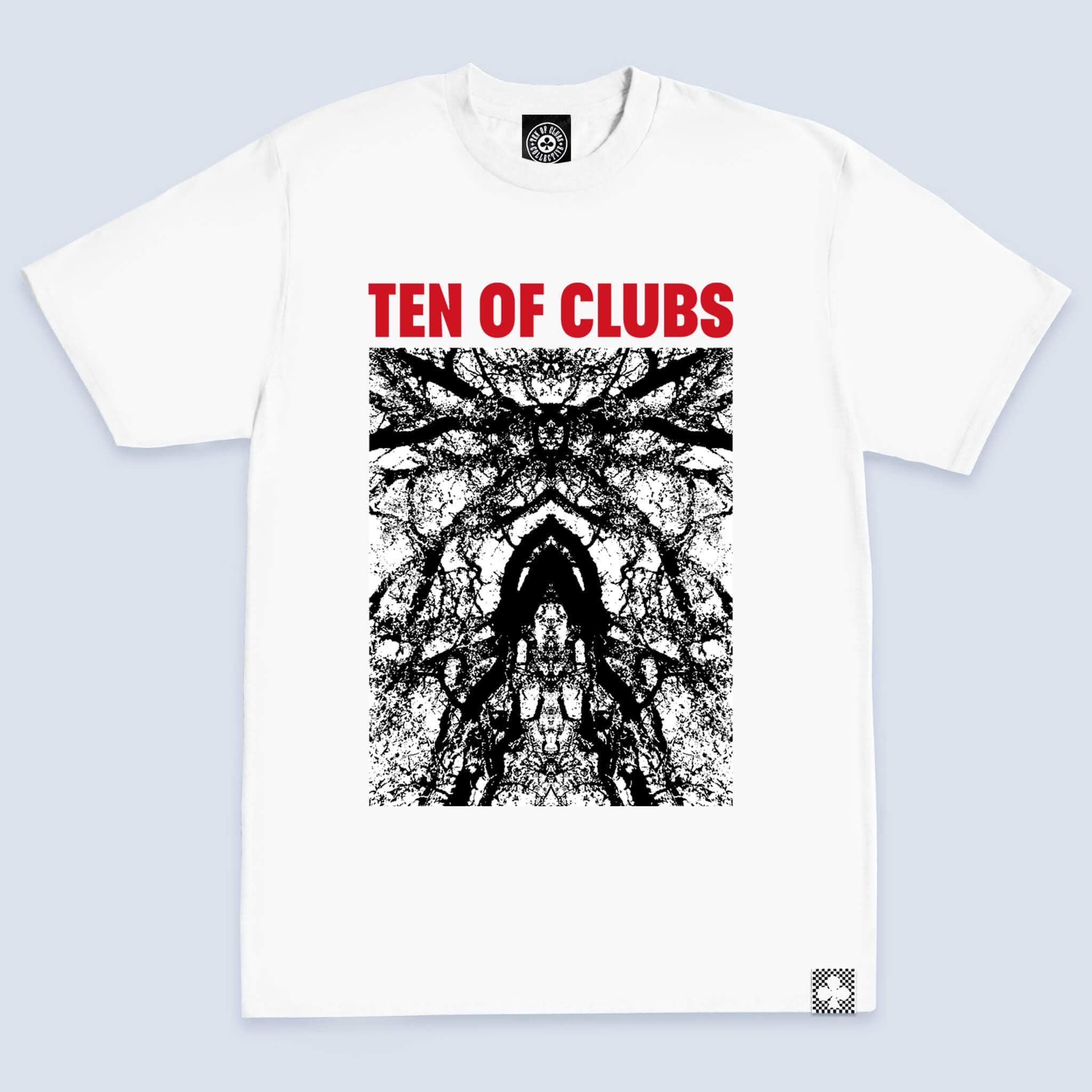
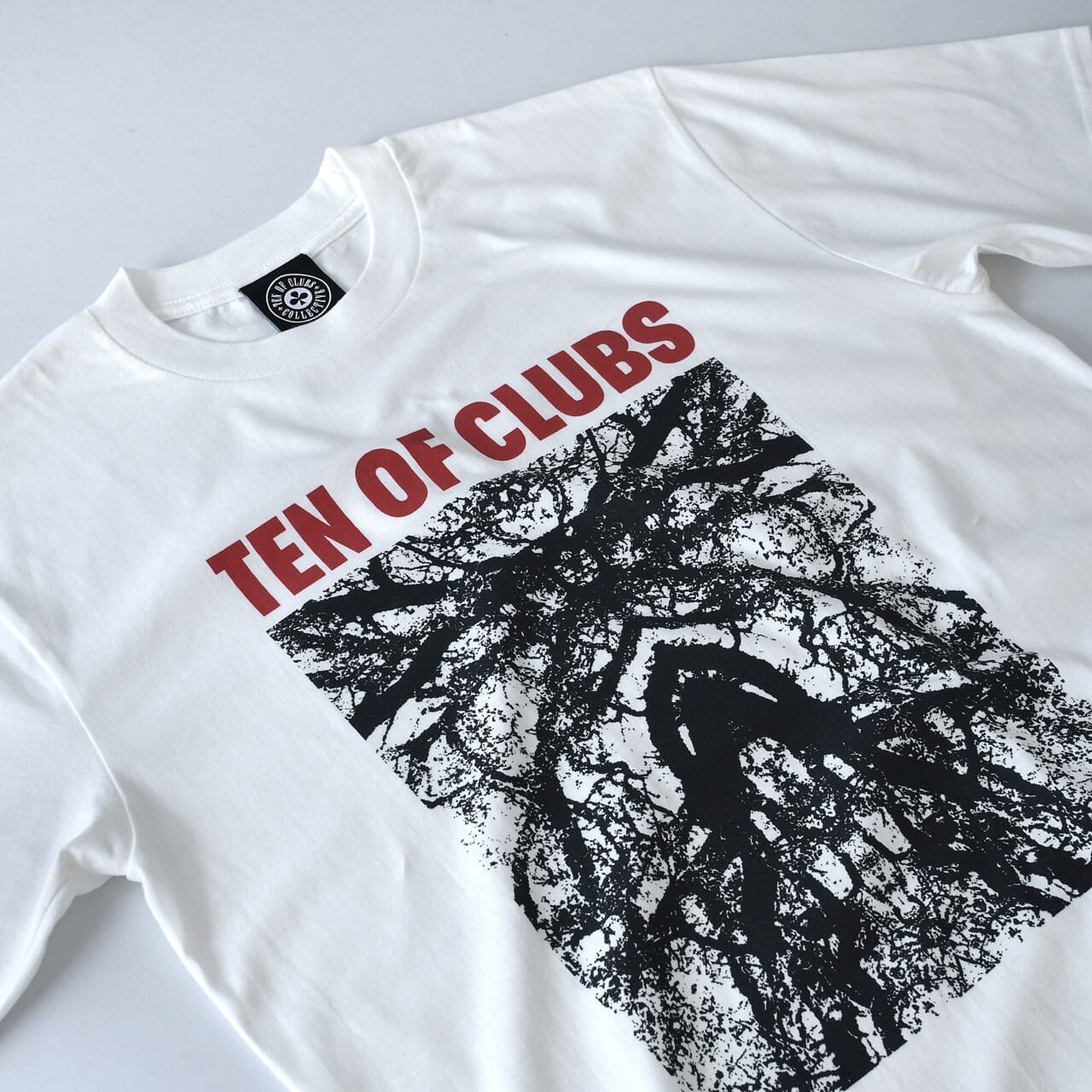
HIGH FADE: SCHÖN FUNKY, WENN'S FUNKTIONJERT